Entity-Specific Historical FX Rates for Acquisitions — A More Accurate IFRS Translation
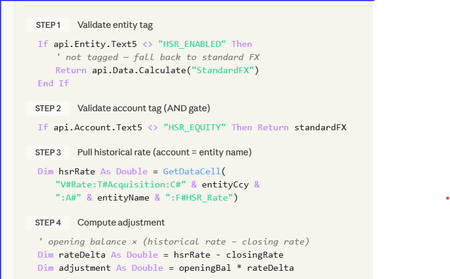
Stop Fighting Your Equity Translation — Let HSR Do the Heavy Lifting A 5-minute read for anyone who's ever stared at a CTA movement and whispered: “Where did that come from?” _____________________________________________________________________________ The consolidation problem we all know It’s day 4 of close. Consolidation runs clean. FX looks fine. Then someone opens the equity rollforward. “Why is acquired share capital moving again?” The entity was acquired years ago at a historical acquisition rate, but the system is retranslating equity at current closing FX every month. CTA absorbs the movement. Auditors ask questions. Finance posts manual journals. Everyone loses time. This is the classic Historical Spot Rate (HSR) challenge. The design principle The goal was simple: Freeze selected equity accounts at acquisition FX rates while keeping the standard OneStream Software translation engine intact. No new cube. No custom dimensions. No complicated override framework. Just: metadata tagging, controlled FX logic, and safe fallback behaviour. The HSR pattern Component Design Entity activation Entity.Text5 = "HSR_Entity" Equity tagging Account.Text15 = "HSR_Accounts" Historic rates Stored in dedicated HSR rate technical accounts Translation logic Finance Business Rule Audit trail Dedicated FX movement flow HSR = Historical Spot Rate. The rule only activates when BOTH: The entity is tagged, and The account is tagged. This creates a simple but effective control framework. The historic rate storage design should remain flexible: use technical accounts, use whatever Text property the project governance model agrees on, and confirm all translation account tagging requirements with the Group Reporting Manager before deployment. What does the rule actually do? Check if Entity is HSR_Entity Check if Account is HSR_Accounts Retrieve stored historic rate Calculate FX adjustment Post adjustment to MVMT_TRANS_FX If anything fails → revert to standard FX That last line is important. The design intentionally prioritises: consolidation stability, auditability, and safe fallback behaviour. If metadata is incomplete or a rate is missing, the application simply reverts to standard FX translation logic. No broken consolidations. No blocked close process. Why did this work well in practice? The biggest advantage was operational simplicity. Adding a newly acquired entity became: Load historic rate Apply metadata tags Run consolidation No code changes required. The approach also kept: CTA cleaner, Equity movements are more stable, And audit support is significantly easier. The real challenge: governance The code itself was straightforward. The harder part was operational discipline: Maintaining 1:1 entity-to-rate mapping Controlling metadata tagging Defining fallback expectations Building reconciliation reporting Testing CTA behaviour thoroughly In my experience, most FX translation problems are not technical problems. They are governance problems. Community question I’d be interested to hear how other certified OneStream Software architects and administrators are handling Historical Spot Rate scenarios. Particularly: Are you using metadata-driven activation? How are you storing historic rates? Have you handled HSR entirely through translation override logic? Any alternative designs that further reduce maintenance? How are you handling CTA transparency and audit reporting? Always interested in seeing cleaner or more efficient approaches from the community.7Views0likes0Comments
Missing underscore in member names displayed via combo box
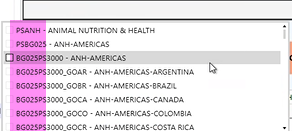
Hello! We have a missing underscore in a combo box and I'm not exactly sure why... Here's what shows: Here's how entities are set up: Anyone see this before? Seems related to this one which says it's resolved in 7.1.3 but I'm not seeing that: Underscore in member name not displaying in multiselect listbox | OneStream CommunitySolved53Views0likes3Comments
Select Currency Property for Entity Member
While building the hierarchy using codes, In the Entity Dimension hierarchy "EntityH1", I have a base member as "MyBase". Below code is successfully creating a new child member as "T2" under Parent "MyBase". I am able to set the Text1 property. Can please some one help to suggest how to set Currency property to select a particular currency (Let's take "SGD") 'Set the Dimension Type as Entity Dim objMemberPk As New MemberPk(DimType.Entity.Id, DimConstants.Unknown) 'Update Dim Name accordingly Dim objDim As OneStream.Shared.Wcf.Dim = BRApi.Finance.Dim.GetDim(si, "EntityH1") 'Create New Member Dim objMember As New Member(objMemberPk, "T2", "T2 Entities", objDim.DimPk.DimId) 'Create VaryingMemberProperties object Dim objProperties As New VaryingMemberProperties(objMemberPk.DimTypeId, objMemberPk.MemberId, DimConstants.Unknown) 'Create new member info object for new member Dim objMemberInfo As New MemberInfo(objMember, objProperties, Nothing, objDim, DimConstants.Unknown) 'Modify some member properties. Entity dimension, in this example. Dim entityProperties As EntityVMProperties = objMemberInfo.GetEntityProperties() entityProperties.Text1.SetStoredValue(ScenarioType.Unknown.Id, DimConstants.Unknown, "Test Entity Text1") 'Save the member and its properties. Dim isNew As TriStateBool = TriStateBool.TrueValue BRApi.Finance.MemberAdmin.SaveMemberInfo(si, objMemberInfo, True, True, False, isNew) objMember = BRApi.Finance.Members.ReadMemberNoCache(si, objMemberPk.DimTypeId, "T2") 'Create Parent Child Relationship Dim rowParentID As String = BRApi.Finance.Members.GetMemberId(si, objMemberPk.DimTypeId, "MyBase") Dim relToCreatePk As New RelationshipPk(objMemberPk.DimTypeId, rowParentID, objMember.MemberId) Dim relToCreate As New Relationship(relToCreatePk, objMember.DimId, RelationshipMovementType.InsertAsLastSibling, 1) Dim relToCreateInfo As New RelationshipInfo(relToCreate, Nothing) Dim relPostionOpt As New RelationshipPositionOptions(RelationshipMovementType.InsertAsLastSibling, 1) brapi.Finance.MemberAdmin.SaveRelationshipInfo(si, relToCreateInfo, relPostionOpt)Solved29Views0likes1CommentHybrid Scenario Issue: Copying Single Period Without Affecting Prior Months
Hello everyone, I’m encountering an issue with Hybrid Scenarios: I’m trying to copy data for a single period only. While I’ve successfully managed to copy Local data for that specific period by updating calc status, the results become inconsistent from Translated up to Top. To align the data from Translated through to Top in the target scenario, I currently need to run a Force Consolidate. However, doing so also brings in data from previous months, which is not desired. Has anyone faced a similar issue or found a way to restrict the consolidation to a single period without impacting prior periods? Thanks in advance,20Views0likes0CommentsOS 9.2 Form Templates Parameters
Hi All, I have a cube view with a set of parameters as a member list. I attach the CV to a form template and override the cube view parameters by using the 'cube view parameters' feature in the form template. As an administrator, I can see the filters I added in the drop-down list, but for the end-user, it is completely blank. (See photo). All dimensions displayed are set to everyone, including templates, cube views, and workspaces. What is causing the issue? In 9.2, the members do not appear in the member list.18Views0likes0Comments
Issue Referencing Parent Entity in an Stored Account Member formula
Hi, We have a few accounts that contain stored formulas. These accounts contain formulas that reference another Account and Parent entity and it stores the result at a Base Entity. Below formula is for an account that has a formula pass 4. We are storing the result in "BaseEntity" and calculate Account1 by looking at OPEX at a Parent Entity. Obviously, since it is referencing a Parent Entity we have to run our consolidations twice in order to get the result. Is there a way to sum up the Base entities of Parent1 and reference that value in a formula or is there a way to run a consolidation within the formula for just that Parent Entity? In other CPM/EPM products I've worked with in the past you can right rules where you run an aggregation on the Entity and then run your calculation. In OneStream I cannot seem to find a way to do this. If api.Pov.Entity.Name = "BaseEntity" Then api.Data.ClearCalculatedData("A#Account1",True,False,False,True) api.Data.Calculate("A#Account1 = A#OPEX:E#Parent1:C#USD",True) End If Any help or assistance would be appreciated. Thanks John19Views0likes0Comments
Write Data to Dynamic Dimensions
I've been going through some training material on DCS for a use case that requires frequent changes in a dimension (UD3 - SKU). Because of this, I'm considering dynamic dimensions where the SKU can be written and generated via code. Unfortunately, I haven't found anything that supports writing data from a cube view. I've only found material that says the "Dynamic Cube" needs to have the share and edit feature turned on. Question - Is it even possible to create a cube, use a dynamic dimension as one of its dimensions, write allocation calcs to allocate data to SKU level and be able to modify that data using cube views? If not, what is the best way to handle this use case without having to create another non-dynamic SKU dimension.Solved133Views1like3CommentsSame Scenario Across Two Cubes vs Separate Scenarios — Pros & Cons?
Hello everyone, I’m looking for feedback on the pros and cons of using a single Actual scenario across two cubes (e.g., Consolidation and FP&A) versus defining separate scenarios for each cube. For example: Option 1 (shared): Consolidation Cube : Actual (Scenario Type = Actual) FP&A Cube : Actual (Scenario Type = Actual) Option 2 (separate): Consolidation Cube : Actual (Scenario Type = Actual) FP&A Cube : Monthly (Scenario Type = Control) From your experience, how do these approaches compare in terms of data governance, maintenance, performance, flexibility for planning/reporting, and potential risks (e.g., unintended impacts between cubes)? Any best practices or lessons learned would be greatly appreciated. Thanks in advance!32Views0likes0CommentsError processing member. The item was not found. Member, -100.
I am running a cube view form in a workflow from OnePlace, i can able to execute other forms like Total Revenue, COGS, IC COGS, OPEX etc but not IC Revenue, Need help, if anybody come across this. Error processing member. The item was not found. Member, -100. Error Description: Unable to execute Business Rule 'CFO_NoInputRule'. Error processing member. The item was not found. Member, -100. User Interface Stack Trace: at OneStream.Client.Api.DataExplorerServiceReference.DataExplorerServiceClient.StartOpenCubeViewGridCompressed(SessionInfo si, Guid workspaceID, String cubeViewName, CubeViewUIModuleType uiType, Dictionary`2 customSubstVars, TriStateBool suppressRows, Int32 pageIndexForPreviousPage, CVGRowOrColUniqueIDStruct lastRowIDInPreviousPage, Int32 compressedRowIndex, List`1 overridenCubeViewMemberExpansions) at OneStream.Client.SharedUI.DataExplorerControl.InitializeGridAsync(TriStateBool suppressRows)44Views0likes2Comments"In Use" property: Time and Scenario Dependent maintenance
Hello All, for our project, we are using the In Use property in UD2 with the Time/Scenario dependency option. Seems to work but the problem for us and also raised by customer is the maintenance part of it. We showed them how to use Grid View but with that we are not able to see how this In Use property is configured by scenario and time. Grid View only shows In Use ticked box everywhere even if we set it to False for some scenario/time combinations. This is really a drawback for us now in implementation phase and for them in the future to administer this application. Does anybody that used scenario/time dependant set up (whether for in use property or for any text attributes, that would be same problem) had a good way to maintain this property without having to go one by one in each member to see what is configured and update it ? Or did you achieve differently the requirement to handle the fact to activate/inactivate some members over time without using the In Use property ? Thank you in advance for your support and feedbacks on that!Solved234Views0likes4Comments