The OneStream Community is temporarily frozen until June 29th due to the ongoing maintenance. Please read the blog post here to learn more.
Data Sources
210 Topics
How can I force a delimited data source to not skip blank values in an Amount field?
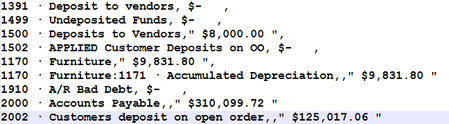
I have a situation where I'm trying to load trial balances from QuickBooks. The source file I'm receiving has three comma-separated columns - Account+Description, Debit, Credit. QuickBooks has a quirky output format where some debit balances are shown as "$-" (presumably to represent 0.00), leaving the credit column blank. If there is a credit value in the credit column, the debit column is blank. This is messing with OneStream's numeric processing of the Amount column when Amount is mapped to Column 2 (Debit column). It is rejecting the "$-" field values and the blank field values as Non-Numeric Amounts (verified in the XFL log file for the load). I can successfully replace '$-' with 0 using the Substitute Settings in the data source's Amount dimension, but I cannot figure out how to replace 'no value' in the Debit column with 0 (so that the valid Credit column values don't get skipped). I'm using a Parser Business Rule to return the net amount (debit column 2 minus credit column 3) for the Amount value, but the records where the Debit column is blank never make it to the parser rule (e.g. accounts 1170, 2000, and 2002 in the screen capture of the source file) because of OneStream's built-in Non-Numeric Amount preprocessing. I've tried various combinations in the Substitution Strings settings, hoping to find one that replaces the empty field with '0', but with no luck. I've tried all of the following Find combinations (the '$-' does successfully produce a 0 by the way). And yes, I know the documentation lists |Null| as a valid Replace value, not a Find value, but I thought I would try it in the Find string just to see if it worked: $-^ ^$- |Null|^$- $-^|Null|73Views0likes2Comments
Monthly Data from D365 into OneStream
Is there an interface from Dynamics 365 into OneStream? I have seen some comments mention direct connection with D365 using oData API. We have several business units across the world that will need to push month end data from D365. Is there a way they can just push the data from their end or would it have to come from OneStream to get the data?110Views0likes5Comments
Best Practice for Managing Outdated Members in Transformation Rules?
We have recently received feedback from several entities regarding outdated account members that still exist within our Transformation Rules. Before making any changes, I wanted to gather input on best practices for handling these scenarios. Specifically, I’m unsure whether it is appropriate to remove or delete these members, or if they should be retained and continue to be mapped for historical reporting purposes. If anyone has guidance or experience with managing outdated members in Transformation Rules, your insight would be greatly appreciated.92Views0likes3Comments
Annotations Extraction via CubeView
Hi All, I am trying to extract the annotations uploaded by our entities by creating a cubeview. I entered all relevant POV information in the cubeview, however, no annotations show. Does any of you have experience with extracting annotations via a cube view?74Views0likes1Comment
Best practice for filtering vStageSourceAndTargetDataWithAttributes by Workflow
Hi everyone, I am building a query using the vStageSourceAndTargetDataWithAttributes view and I want to ensure I am retrieving the latest figures for a specific Entity and Time period. I have a few questions regarding the best way to filter this: Filtering by Wfk: I know that hardcoding a GUID for the Wfk (Workflow Key) is risky because it can change between environments or if a profile is reset. What is the recommended way to dynamically filter for a specific Workflow Profile? Should I be joining on the WorkflowProfileHierarchy table/view to filter by ProfileName? Latest Figures: If multiple imports have occurred, does filtering by a specific Wfk automatically ensure I am seeing the "latest" iteration of the data, or is there a better field to use for partitioning/ranking the results? Any code snippets or best practices for making these stage queries robust would be highly appreciated.87Views0likes2Comments
CAMT.053 Files (ISO20022)
Has anyone imported CAMT.053 files from their bank into OneStream? We are embarking on an Account Reconciliation project and trying to accommodate our international sites. We've been told this is tricky and to stick with the BAI format, but that will be problematic as we integrate more global entities.Solved144Views0likes3Comments
Europe SWIFT File
Hello, I have a SWIFT Bank file from a client based in Europe that I need to import. I thought this would be similar to a BAI file and could use the OS BAI Parser solution to grab the necessary information, but the format isn't as similar as I thought. Is there any other tool for parsing out a SWIFT file or will this require some custom logic?Delimited file Import and normalization
Hi everyone, I need to set up a few transformations to normalize a delimited file that will be uploaded by the users, before feeding it to the datasource. I previously worked with FTP folders, and used a Connector BR to retrieve data and normalize it before the datasource step. I have never worked with delimited files loaded directly by clicking Import. It's not clear to me if I can still use a connector BR or if I need to use something else (a Parser BR?). Can anyone help me understand what is the best practice in this case? Thank you for the support!Solved161Views0likes3Commentsloading sub-ledger data into OneStream
Hi Community :) We are currently in development with regard to loading sub-ledger data into OneStream, but the balance specifications are so granular that we currently have them split into about 10 distinct loads. Because of this setup, our end users are being forced to manually click "Load and Transform" 10+ times to get a complete sub-ledger balance loaded for the period. Obviously, this is tedious, creates a poor user experience, and introduces a lot of room for human error. We want to streamline this. What is best practice to do this?125Views0likes2CommentsHow to "Import" "in parallel" via a "OneStream Connector" to a "Data Warehouse"?
Please share your practical advice to help us meet the new Integration requirements. - I couldn't find a OneStream KB/post nor a good result from free Gemini. - We're using SAAS on v9.0 to move to v10 upon its upcoming release. Thank you folks for sharing your expertise.120Views1like2Comments