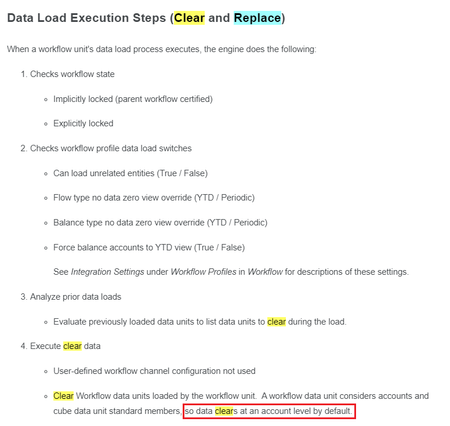
Clear data using level 1 data unit (rather than level 2) on data load
Hi all I was wondering if it is possible to override the default 'clear and load' settings on a data load step from 'Level 2: Workflow Data Unit' to 'Level 1: Cube Data Unit' Just to give a bit of context: We perform a data copy from a Budget scenario (using Data Management Sequence) to a Forecast scenario to provide a starting data position for divisions to use when they capture their forecast data. Once the data copy is complete, the process for divisions to update their forecasts is to extract an Excel Fixed File Template on which they will make their changes and additions over the copied Budget data, and then to import that file via their Workflow to the cube. However, when wanting to remove an account for instance, the only way to do so it to load zeros to that account. This is because the load clears by account and not entity. Is it possible to change the load so that it deletes all accounts? Thanks, Mark1.4KViews2likes3Comments
Excel Template upload - Data Source setup
Hi All, I'm trying to set up some Excel templates for the uploading Budget and Forecast data. I'm pretty happy with the Excel Template side, with the named range (XFD), and specific header formats, etc. However, I'm a bit lost on the Data Source set up, I get that you have to Allow Dynamic Excel Loads set to True, but what about the rest of the set up? Do I choose Delimited or Fixed file? It feels like this Data Source section is really for flat files, as it always wants to know the column number. I've tried importing the Excel into the Data Source in the same way I would for a csv file, but it just shows up as xml gibberish in the top box. It definitely feels like I'm missing something.Solved5.3KViews2likes5CommentsSo you have upgraded to 7.1.1 version . Check out the known error-
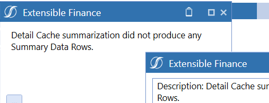
You will get this error during the import step. Reason - The load file doesnt have any data after transformation.( ByPass). The underlying code looks to summarize the data when it finds nothing, it throws an error.1.3KViews1like1Comment
"Cannot execute step because the prior workflow step is not completed"
We have Workflow A, and Workflow B. We get an error when the loadCube step in workflow B, when Workflow A is in Validation step. The error we get is "Cannot execute step because the prior workflow step is not completed. . (WP#WorkflowA.Import:S#Actual:T#2022M1)" The name the actual workflow has been changed to protect the innocent. Our question is: what is causing this issue and how do we fix it? It's not clear in the documentation what exactly triggers this error message. The parameters passed back imply that one cannot load to the same scenario and time if another workflow to that scenario and time is still open. WorkflowA and WorkflowB are loading to the same scenario and time, but to different accounts.5.2KViews1like5CommentsBest Practice to Clear Stage Data Globally and Cube Data for Selected Entities
Hi Team, I’m looking for guidance on the best approach to clear data in OneStream. My requirement is twofold: Clear all data from the Stage area For a selected set of entities, clear both Stage and Cube data I’m particularly interested in understanding the most efficient and recommended way to handle this, while ensuring data integrity and minimizing any unintended impact. Specifically, I would appreciate insights on: Recommended methods to clear Stage data globally (e.g., via Data Management steps, Business Rules, or utilities) The best approach to selectively clear Cube data for specific entities Any considerations around workflow locks, data unit locking, or audit/history implications Performance best practices and recommended sequence of operations If anyone has implemented a similar requirement, I’d love to hear your approach or any lessons learned. Thanks in advance for your help!174Views1like2CommentsHow to "Import" "in parallel" via a "OneStream Connector" to a "Data Warehouse"?
Please share your practical advice to help us meet the new Integration requirements. - I couldn't find a OneStream KB/post nor a good result from free Gemini. - We're using SAAS on v9.0 to move to v10 upon its upcoming release. Thank you folks for sharing your expertise.112Views1like2Comments
Connect MS Fabric Lakehouse?
Hi all, I'm currently exploring ways to extract data from a Microsoft Fabric Lakehouse into OneStream. The obvious way would be to connect to the SQL endpoint just like any other DB. In this case, what would be the best authentication method? I've been testing it out with my own user on MS SQL Server Management Studio using MFA, and I have no idea what the best way would be to create credentials for the connection string in OneStream. In case connecting to the SQL endpoint with a connection string isn't a good idea, what would be a better practice? Thanks.Solved115Views1like1Comment
Central Import and Account Reconciliations
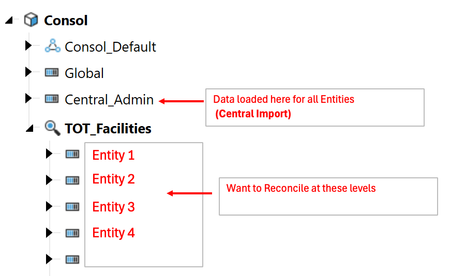
I’m starting an Account Reconciliations implementation and the current process loads Actuals for all entities through a central import. They do have individual workflows for each entity where security is assigned at that level and used for planning and reporting. For RCM they want to look at their recs at that level too (WF entity) but data is not flowing through. Did the discovery both at the Central and individual levels and only the Central inventory is being populated. I guess it’s because data is not being loaded to stage into those WFs. Is there a way to work around this or will data need to be loaded at the entity level for it to work?Solved134Views1like2Comments
Errors creating New Task in Data Import Schedule Manager
I am getting several errors when setting up a New Task in the Data Import Schedule Manager. We are on OS version 9.01.17403, and I have installed the latest version of DSM, which is 8.4.0_SV100. I suspect this may be a version compatibility issue, so I am curious if anyone has been able to get this solution to work in a 9.01 application. I have already uninstalled and reinstalled the solution, which didn’t resolve the issues. Below are the two errors I am seeing: When choosing Global Scenario from the Scenario(s) drop down list, I get an immediate error “Error processing member. The item was not found. Member, 11111111.” The details state: Unable to execute Business Rule ‘DSM_Paramhelper’ where it appears to be trying to call the Global Scenario by OneStream.Client.Api.DashboardsAjaxServiceReference.DashboardsAjaxServiceClient.GetParameterDisplayInfosUsingDashboardNameCompressed(SessionInfo si, LoadDashboardInfo loadDashboardInfo, Boolean isForDashboardUIWithInteractiveComponents, Dictionary`2 custSubstVarsAlreadyResolved). If I pick a specific Scenario, I am getting a different error. It allows me to pick the Scenario and Time, but when save the Task, I get “The input string ‘’ was not in a correct format.”. The error details show it is an issue with the same Business Rule ‘DSM_SolutionHelper’ where Conversion from string “” to type ‘Double’ is not valid. The input string ‘’ was not in a correct format. OneStream.Client.Api.DashboardsAjaxServiceReference.DashboardsAjaxServiceClient.StartExecuteSelectionChangedServerTaskCompressed(SessionInfo si, Boolean isSystemLevel, Guid primaryDashboardID, Guid embeddedDashboardID, Guid componentID, PageInstanceInfo pageInstanceInfo, XFSelectionChangedServerTaskInfo serverTaskInfo) Any advice on how to correct these issues would be greatly appreciated.Solved128Views1like1CommentWorkflow Import - Clearing cube data in v9
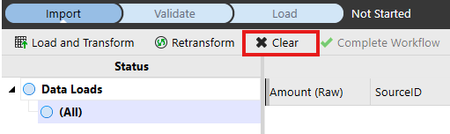
Hello, we recently upgraded to v9 and noticed that we can no longer clear WF imported cube data using the "Clear" option through the workflow import (snip below). Prior to the upgrade, we could clear the stage data, then run import/validate/load to clear the data that was imported to the cube. Now, this option only clears the data from stage and in order to clear the data loaded to the cube, we have to use a data management step. In our case, this is now difficult because the data loaded may be specific to workflow channels and also use multiple dimension criteria and not just Entity (used by DM step). Is anyone else having this issue? Are there any other methods to removing the imported data via csv file from the cube other than a DM step? If we try to run the old process in v9. Clear, then Retransform, Load to clear cube data. This error appears.Solved562Views1like7Comments