V9.1.1 Grid view error when updating IsIC setting
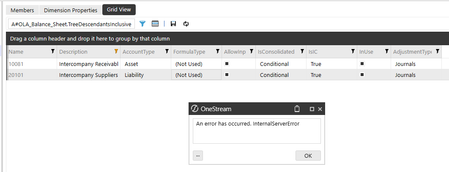
In Grid view on the Account Dimension, when attempting to update the IsIC setting for an account I receive an Internal Server Error. I'm able to update the Is IC Account on the Member Properties view, however in Grid view it returns the error below:Solved74Views5likes2Comments
Metadata builder and extensibility
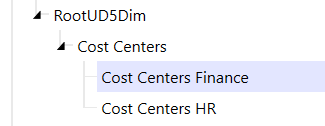
Hi everyone, I am currently using the metadata builder in excel to maintain and keep updated the hierarchies of all dimensions, but I'm having an issue in loading two separate dimensions for UD5. I was planning to build the U5 dimensions as follows: within each dimension, I would have the same base members organized in different hierarchical structures (aka same base members but different nodes between Finance and HR). In Excel, I divided the two dimensions in two separate sheets, because I can reference one dimension at a time in each sheet when I load the XML of the first dimension, I have no issues and the dimension loads as expected. If I make a change to the configuration of that same dimension and load the new xml, I still get no issues. The problem arises when I try to load the XML of the second dimension. The error I get is the following: Error processing XML file type 'Metadata'. Error processing XML. The specified member does not belong to the encompassing dimension. 169989, Cost Centers HR. XML line 127, position 7, element member. The 169989 member is the first base member in the HR dimension. It seems the system refuses to load members that already exist in the Finance dimension. My questions are the following: Is there a problem in the way I designed the UD5 dimensions in excel? OR is it normal that the same base dimension can be loaded for one dimension only, and the second XML (for the HR dimension) should only include the new relationships between the already existing base members and the new nodes of the HR dimension? Thank you in advance for any help, feel free to ask additional info if needed108Views2likes1CommentUD or attribute to flag past restatements (Budget pot swaps)
Hello, we are about to start our work on next year budget and we already know that, following a recent restructuration, there will be a lot of pot swaps between departments (e.g. Licence costs used to sit in the department using the software but will now all sit under IT). Some of the them will be just moving a cost center and its history from one department to the next so that will be easy. Our issue is when we do a "pot swap" that moves part of a cost center. In this case we will have a disconnect when we compare actual and forecast unless we restate actual (i.e. also move the cost in actual). My question is on how best to tag/flag the "pot swap" in the actual data so that in reporting we can do like of like comparison (i.e. with past data restated) but also keep the original data. I have 2 potentials solutions: Flag the restatement using an UD: do the restatement of past periods under a specific UD so that we have the ability to see past periods with or without pot swap adjustments Use attributes: I think attributes would work but we have not used attributes in the past so not sure whether it is the best way Does anyone have the same issue and came up with an alternative solution? or has a view on the above options? Many thanks!Solved57Views2likes2Comments
Preventing YTD true up for Attribute Member?
Hi, I've set up Attribute Members in my application. They are using Text fields in my UD3 dimension and the Attribute Members are in my UD6 dimension. For default Text values, it works great. However, if I want to make a time-dependent change, it does a YTD true-up on any values. For example, let's say I have a member "Member1" with the default value "Smith" and 1,000 per month. If I want the Text value to be "Jones" starting in M4, I make that change in the Text field for that period. When I view the data, the Smith row will have 1,000 for 3 months and then -3,000 in month 4 and the Jones row will have 4,000 in month 4 and 1,000 per month after that. Is there any way to prevent that YTD true up? I just want the amounts to stop for Smith and start for Jones without the true up?3.2KViews2likes6CommentsCan a Data Mgmt Data Extract step be saved somewhere other than under that user's folder?
When running a Data Mgmt Data Extract step, you can chose where you want the file saved: However, the name you provide always starts under the File Share\Applications\[App Name]\DataManagement\Export\[User Name] folder. So, the above extract would show up as File Share\Applications\MyApp\DataManagement\Export\Phil\20211202\CubeData.csv We need these extracts to be available to users who do not have access to the individual user folders on the File Share (i.e. - they aren't Admins) Is there a way to have the Data Extract saved to a truly user defined location, like Application Database\Documents\Public\DataExtracts? How could this be done? If you run the extract from a business rule are there arguments you can pass into the data management call to override the export path? Or is there a way to programmatically move the file after it's been created? Thanks,3KViews2likes2Comments
usage of Aggregated member from Consolidation dimension
At the moment the Aggregated member uses the IsConsolidated property to aggregate or not. Do I have any option if I wanted to aggregate a member but not consolidate it? With the introduction of the new member Aggregated, is there going to be a IsAggregated property created or will it always work with the IsConsolidated property? Thanks1.7KViews2likes1CommentUsing Variance Explanations and UD8 (Dynamic calc periods) together
Originally posted by Felipe Alcorta Hello: We'd like to incorporate variance explanations into our cube views. If the cube view shows one periodic comparison (e.g. Jun YTD CY vs June YTD PY), we have a corresponding dynamic calc that calculates the variance and we can use the (out of the box) variance explanation from the View dimension in order to have comment/explanation functionality. However, if we have multiple comparison period in the same column template/cube view, we are unable to. If we take the same approach as one periodic comparison, the same comment would appear in both comparison columns since there's nothing to distinguish which periodic comparisons are being explained against. We tried using a placeholder UD8 elements (no formulas) in addition to the variance explanation from View dimension but OneStream says it's an invalid cell. Advice?1.4KViews1like0Comments
Data Copy from Application 1 to Application 2 (Different Environment hosted on Azure)
Hi Team, We would like to understand how to copy data from some specific tables from appsuite(appsuite-prd.onestreamcloud.com) to appsuite_dev(appsuite-dev.onestreamcloud.com) for some specific tables.1.9KViews1like1CommentWrite Data to Dynamic Dimensions
I've been going through some training material on DCS for a use case that requires frequent changes in a dimension (UD3 - SKU). Because of this, I'm considering dynamic dimensions where the SKU can be written and generated via code. Unfortunately, I haven't found anything that supports writing data from a cube view. I've only found material that says the "Dynamic Cube" needs to have the share and edit feature turned on. Question - Is it even possible to create a cube, use a dynamic dimension as one of its dimensions, write allocation calcs to allocate data to SKU level and be able to modify that data using cube views? If not, what is the best way to handle this use case without having to create another non-dynamic SKU dimension.Solved179Views1like4Comments