The OneStream Community is temporarily frozen until June 29th due to the ongoing maintenance. Please read the blog post here to learn more.
Recent Blogs
Final Reminder: The OneStream Community Arrives on June 29
1 MIN READ As a final reminder, the new OneStream Community will arrive on June 29, 2026. From June 19 at 2PM CST through June 29, the OneStream Community will be set to read-only mode. At this time, no new content can be posted, likes and comments will be disabled, and all member engagement opportunities will be temporarily frozen. You will still be able to browse and search for content as normal; just no new posts will be possible until the migration to the new platform has been completed. Once the migration is completed, you’ll be able to access the new OneStream Community by clicking the OneStream Community tile in Okta. To learn more about what to expect with the new Community, please read our The New Community Experience Arrives June 29, 2026 post.45Views0likes0CommentsCourse Announcement: Reviewing Introductory OneStream C# Examples
1 MIN READ This OnDemand module is intended for implementors and administrators who are new to coding and/or C# in OneStream. This module reviews introductory C# rules in OneStream. It reviews the XFBR String, Dashboard Data Set, and Dashboard Extender rule types, which are common C# rule types. The module reviews the common use cases and how to create and call the rules. You may encounter C# logic within these rules, and this walkthrough provides an introductory example to help you understand the structure, purpose, and practical use of these rules. Delivery Types: On-Demand (OD) Duration: 45 Minutes Availability: This Course is Free Course Link: Reviewing Introductory OneStream C# Examples23Views0likes0Comments
Build Dashboards with Confidence — and Get Certified for Less (Limited‑Time Offer)
2 MIN READ Great dashboards don’t just look good — they drive clarity, confidence, and better decisions across the business. If you’re responsible for turning data into insight in OneStream, the Building Dashboards Certification is designed to validate exactly that skill set. For a limited time through the end of June, customers who have recently completed the Building Dashboards course are eligible to take the certification exam at a special 50% OFF promotional price. It’s the perfect moment to turn hands‑on learning into a credential that proves real‑world impact. Why Customers Pursue the Building Dashboards Certification Customers working toward this certification typically share the same goals: Deliver dashboards that executives trust and actually use Reduce manual reporting and last‑minute data scrambles Clearly communicate performance, trends, and risks Build repeatable, scalable dashboard designs aligned to business needs Become the go‑to OneStream expert for dashboards and reporting The Building Dashboards Certification confirms you can do more than navigate features — it validates that you can design dashboards that support faster decisions and stronger business outcomes. Start with the Building Dashboards Course The certification is grounded in practical, job‑ready skills taught in the Building Dashboards course, where customers learn to: Design dashboards with purpose — not just visuals Connect business questions to the right KPIs and views Build dashboards that are intuitive, performant, and maintainable Apply best practices you can use immediately in your environment Instructor‑Led Training (ILT) Prefer live instruction and hands‑on guidance? The Building Dashboards course is available on our ILT calendar, giving you the opportunity to learn directly from OneStream experts and collaborate with peers. https://onestream.thoughtindustries.com/pages/instructor-led-training?labels=%5B%22Course%22%5D&values=%5B%22Building%20Dashboards%22%5D On‑Demand Option Need flexibility? The same course is also available On Demand, allowing you to learn at your own pace while still preparing fully for the certification. https://onestream.thoughtindustries.com/courses/building-dashboards?sessionFields=%5B%5B%22premium-training%22%2C%22Essentials%20Series%22%5D%2C%5B%22courses%22%2C%22Building%20Dashboards%22%5D%5D Complete Your Prep with Certification‑Focused Resources Customers preparing for the Building Dashboards Certification can leverage a full set of prep materials to reinforce learning and boost confidence, including: Exam prep webinars that walk-through expectations and key focus areas Practice questions and a study guide aligned to exam objectives Hands‑on labs and exercises that mirror real certification scenarios Our courses and resources are designed to help you connect concepts to real-world application — so nothing on exam day feels unfamiliar. Limited‑Time Exam Promotion — Through End of June If you’ve recently taken the Building Dashboards course, you’re eligible for 50% off the exam when you register before the end of June. ✔ Validate your skills while the content is fresh ✔ Save on exam costs ✔ Earn a credential that demonstrates measurable dashboard expertise Don’t wait — this promotion is only available for a limited time and requires recent course completion. Take the Next Step Whether your goal is to improve executive reporting, streamline insight delivery, or stand out as a OneStream dashboard expert, the Building Dashboards Certification helps you turn learning into recognized capability. How learners redeem promotional price Submit a ServiceNow ticket to the Credentialing team Course completion is verified Credentialing issues a discounted exam voucher41Views0likes0CommentsCourse Announcement: VB.NET Versus C# Reference Guide
1 MIN READ This OnDemand module is intended for implementors and administrators who are new to coding and/or C# in OneStream. It contains a reference guide for VB.NET versus C# code for core C# topics such as data types, variable initialization, collection initialization, operators, jump statements, selection statements, loop statements, and try-catch statements. Delivery Types: On-Demand (OD) Duration: 15 Minutes Availability: This Course is Free Course Link: VB.Net Versus C# Reference Guide29Views0likes0Comments
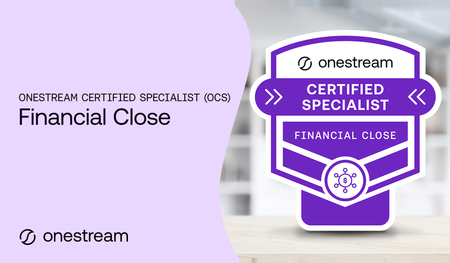
Now Available: The OneStream Certified Specialist Financial Close Exam
2 MIN READ The OneStream Certification Program is pleased to announce the availability of the https://www.onestream.com/ges/certification/exams/ exam! Individuals who successfully earn the OneStream Certified Specialist Financial Close certification are capable of performing Financial Close tasks such as, using Reconciliation Administration, TXM administration, adjustments and journal entries, TXM and reconciliation reporting, data splitting, etc. They are knowledgeable in basic accounting and/or finance principles, have a general understanding of CPM principles, and are ready to be staffed on their first Financial Close project. OneStream Certified Specialists in Financial Close have hands-on experience with the OneStream platform and a track record of successfully providing support or enablement. This exam is based on four courses in the OneStream Solutions series and the OneStream Essential Series: Getting Started with OneStream OneStream Solutions: Implementing OFC Account Reconciliations OneStream Solutions: Implementing OFC Transaction Matching OneStream Solutions: Integrating and Automating OneStream Financial Close (OFC) To prepare for the exam, including exam objectives, learning of recommended courses and real-world experience, download the https://2020381.fs1.hubspotusercontent-na1.net/hubfs/2020381/GES%20-%20Global%20Education%20Services%20-%20Web%20Documents/Certification/Study%20Guide%20-%20Certification%20-%20OCS%20OneStream%20Financial%20Close%20Exam%20-%20OS301.pdf. Register today by logging into CertMetrics and SSO to TestWise! Delivery Type: Remote, Live-proctored via webcam Exam Fee: $1,000.00 USD Duration: 2.5 hours Number of items: 60 to 70 Multiple Choice and 4 Performance-based Tasks Language: English Digital Credential: Yes For any additional questions, please contact the Certification Team by opening a https://onestreamsoftware.service-now.com/ with credentialing. Thank you to the Exam Subject Matter Experts and Contributors! The OneStream Certification Program thanks the following subject matter experts for their valuable contributions throughout the exam development process. Without their dedication and expertise, this exam would not have been possible. Aaron Bolshoun, Compintelligence Cindy Eichner, Finit Daniele Rusconi, Deloitte Dimitrios Christodoulopoulos, Pryzm Global Eric Hanson, OneStream Heather Upton, OneStream Jannesa Zhang, OneStream Justice Dzama, Inplenion Michelle McDevitt, Compintelligence Nicky Baretta, OneStream Patrick Bischof, 4 Solutions Raj Chaudhury, Sky Roq Robinson Wise, Compintelligence65Views0likes0Comments


Tags
- the onestream podcast80 Topics
- tech talks79 Topics
- community updates51 Topics
- training48 Topics
- certification26 Topics
- onestream press26 Topics
- webinars22 Topics
- onestream platform14 Topics
- events9 Topics